|
photographer
born Australia 1900 - USA 1919 - 1982
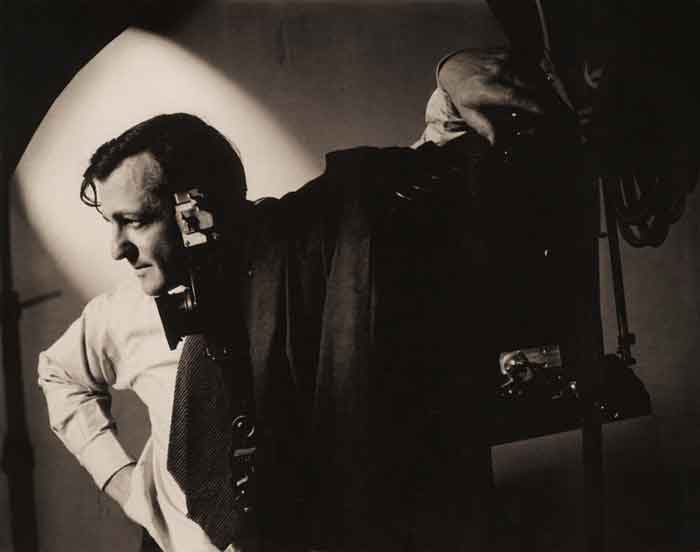 |
| Anton Bruel in the studio, 1937 |
Anton Bruehl was an Australian-born American photographer who became one of the most influential commercial and color photographers of the mid-twentieth century. He was born in 1900 to German émigré parents in the small town of Hawker, South Australia, and trained as an engineer, studying in Melbourne before emigrating.
Bruehl moved to the United States in 1919 to take a job with Western Electric, but an exhibition of student work from the Clarence H. White School of Photography in New York convinced him to abandon engineering for photography. White taught him privately for six months and then invited him to teach at the school, including its summer sessions in Maine.
After White's sudden death in 1925, Bruehl opened his own studio, first partnering with photographer Ralph Steiner and then with his older brother, Martin Bruehl; it was immediately successful.
Specializing in elaborately designed and lit tableaux, Bruehl won top advertising awards throughout the late 1920s and early 1930s. He became known for meticulously staged, richly colored advertisements and theatrical scenes. A representative example is his Four Roses whiskey campaign, in which the product appeared to travel by train, cruise liner, and hot air balloon — scenes that were not darkroom fabrications but arranged by hand with the help of miniaturists, set dressers, and a florist.
Bruehl's most lasting contribution was in color photography. In 1931, publisher Condé Montrose Nast appointed Bruehl to work with the photographer and color technician Fernand Bourges to perfect color photography for Vanity Fair, Vogue, and House & Garden. The resulting Bruehl-Bourges color process gave Condé Nast a near-monopoly on quality color magazine reproduction during the 1930s. Bruehl led the new field of color photography and remained at its forefront until his retirement in 1966.
Art photography and Mexico. Alongside his commercial work, Bruehl maintained a reputation as an art photographer. In 1932 he traveled to Mexico, and the resulting black-and-white images were published in a finely printed, linen-bound book titled Photographs of Mexico (1933), which was well reviewed and named one of the American Institute of Graphic Arts' "Fifty Books of the Year."
Bruehl ran an elegant midtown Manhattan studio and commanded high fees until retiring in 1966. Ansel Adams memorably described his work as "entirely contrived, and yet absolutely sincere," capturing the tension between his theatrical artifice and technical precision.
His photographs are held in major collections including the Museum of Modern Art, the Metropolitan Museum of Art, and the National Gallery of Australia, and he is remembered as a foundational figure in modern advertising photography and the commercial use of color.
Return to Anton Bruehl main page
|